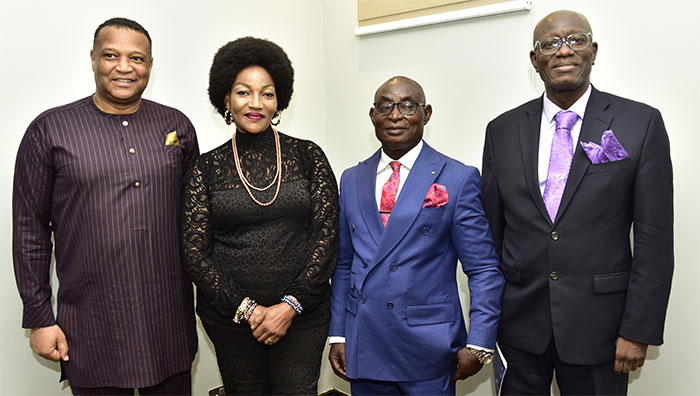
From left — Mr. Obafemi Giwa-Amu, Founder, Zig-zag Nation; Princess Dominica Onugu, Chief Executive Officer, DomBeads Ventures; Mr. Ogbonnaya Agbafo, Principal, Agbafo & Co., Convener, and Mr. Jide Bodede, Principal, Lawfields Solicitors at the one-day investment summit with the theme “Investment as a Desideratum for Economic Re-Birth in Nigeria: Challenges and Prospects,” held in Ikeja, Lagos.
Experts drawn from the industry, academia, trade, and civil society organisations have called for a quick resolution of the misunderstanding that made the Ministry of Interior to revoke the visa and work permit of Mr. Roger Brown, CEO of Seplat Energy Plc.
The experts, at a one-day investment summit hosted by the Barrister Ogbonnaya Agbafo led Factsmill Consulting Limited, in Lagos, were in unison that urgent steps should be taken to quickly nip the misunderstanding in the bud as it could have consequences for Nigeria’s investment climate.
To them, if the Seplat imbroglio festers, both the image of Seplat and Nigeria will continue to be rubbished among investors, local and foreign, and the country’s partners.
In a lead presentation, Prof. Udechukwu Udeke, Head of the Department of History and International Studies, Imo State University, Owerri, contended that the revocation of the visa and work permit of Mr. Brown, a British citizen by the Nigerian government, appeared hasty and was capable of ensuring the further plummeting of the country’s image, especially as Seplat Energy is a burgeoning Nigerian global company quoted on the Nigeria Stock Exchange and also at the London Stock Exchange.
He stated that nothing untoward should be done to further diminish the unflattering global ranking of Nigeria at a time the country was grappling with a disputed election, a currency re-design gone awry and unabating security challenges.
Prof Udeke canvassed for a speedy resolution of the misunderstanding between the Seplat boss and officials of the Ministry of Interior in the interest of the economic growth and image of the country.
“In the current world order where competition for investment is stiff, every country takes measures to attract foreign investment,” he said, “and the present situation at Seplat would not attract investors.”
He listed a good image as a notable factor in attracting investors.
FDI
“Everything,” according to Obafemi Giwa-Amu, a lawyer and founder of Zig-Zag Nation, a vibrant cross-pollination of voices and cultures, “should be done to ensure a salutary image for Nigeria to continue attracting foreign investment for the ultimate growth and development of the economy.”
He noted that Nigeria’s Foreign Direct Investment (FDI) for 2021 was $3.31bn, a 38.9% increase from 2020. For 2020, Nigeria’s FDI stood at $2.39bn, a 3.48% increase for 2019.
According to Statista, between January and March 2022, Foreign Direct Investment inflow into Nigeria amounted to $155 million.
In the 2nd quarter of 2022, the National Bureau of Statistics (NBS) reported that foreign funds invested in the Nigerian economy amounted to $1. 535cbillion, a 75. 34 percent increase from $875 million in the second quarter of 2021.
“The largest amount of capital received,” observed Giwa-Amu, who presided over the one-day investment summit, “was through portfolio investment which accounted for 49.33 percent ($757. 32 million).”
Mr. Lanre Alabi, a former President of the Association of Corporate Affairs Managers of Banks (ACAMB), said the outlook for global Foreign Direct Investment in 2023 appears bleak.
“Negative slow growth in many economies, further deteriorating financial conditions, investor uncertainty in the face of multiple crises especially in developing countries, increasing debt related risks will put significant downward pressure on Foreign Direct Investment.
“In Nigeria, Africa’s biggest economy, attracting Foreign Direct Investment this year will be challenged by a post pandemic world or Russia/Ukraine war era in which access to capital will be keenly contested.”
He suggested that the government should consider these and review its decision on Seplat.
However, Communications Consultant and Development Expert, Dr. Tony Onyima, reiterated that the projected decline in foreign direct investment will weaken the Nigeria economy.
“Part of the measures to be adopted to stave off such negative development is for the nation to become more productive and bolster her image and make the country attractive to foreign investors,” he said.
To Onyima, a former Commissioner of Information and Orientation in Anambra, no serious investor will be attracted to a country were genuine investors are discarded whimsically.
He referred to the recent event that warranted the exit of the CEO of Seplat Energy from Nigeria.
Onyima opined that the government should not have allowed things to the generate to the level of revoking the visa and work permit of Mr. Brown.
“That singular action,” Onyima contended, “could shake investors’ confidence in Nigeria and should be resolved through diplomatic channels between Nigeria and Britain.
“Nigeria, a country rich in natural resources and human capital, is Africa’s largest economy. With a population of over 200 million, Nigeria has the potential to be one of the most influential countries in the world.
“However, it is not always easy for people to invest their money in the country because many different types of investments impediments could be faced in Nigeria.
“The government has always avowed its determination to make the country an investment haven. To show how determined the government is in this regard, an Ease of Doing Business policy was not only enunciated but its been driven by Vice President Yemi Osinbajo.”
Experts at the one-day investment summit were unanimous that such self-inflicted injury like the hasty denouncement of Mr. Brown will but roll back otherwise noble efforts to attract investment and indeed foreign direct capital to Nigeria in ample and enduring manner and that will take its toll on revenue, employment, education, health care and other ingredients of the Millennium Development Goals (MDG).
They advised the government to engage more with investors in Nigeria, without waiting until issues arose, as one of the measures to retain existing investors, and attract more investors.
Disclaimer
Comments expressed here do not reflect the opinions of Vanguard newspapers or any employee thereof.