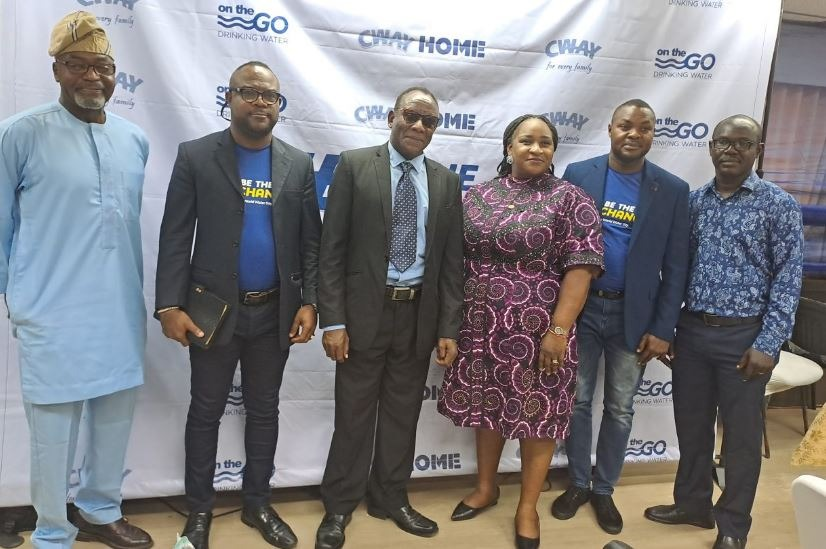
From left, Deji Johnson, Chief Operating Officer, Lagos Water Corporation; Abiodun Suleiman, Sales Director, Cway Group; Dr Roland Uwadiae, Associate Professor, Dept. of Marine Sciences, UNILAG; Mrs Koko Faderera, Land and Water Pollution Control Dept, LASEPA; Samuel Akinrinmisi, Deputy Marketing Director, Cway Foods; and James Oloyede, Deputy Director, Ministry of Environment and Water Resources, at the Cway Group 2023 World Water Day Celebration, In Lagos.
By Etop Ekanem
An Associate Professor of Department of Marine Sciences, University of Lagos, Prof Rowland Uwadiae, has said water recycling and reuse should enter Nigeria’s legal portfolio.
According to Uwadiae, who is a marine scientist, Nigeria should strive to overcome water scarcity which constitutes a threat to water security.
He stated these during this year’s World Water Day celebration organised by CWAY Group, a leading manufacturer and distributor of drinking water, in Lagos.
According to him, due to careless domestic, industrial and agricultural uses of water; resources in rivers, boreholes, water tables, dams and reservoirs were under pressure and rapidly being depleted.
He said: “Nigeria has economic water scarcity when compared with other countries. Nigeria has water but lacks infrastructure to distribute the water to citizens in dire need of it. Securing resources means finding the additional water resources needed to meet demand and respect the balance.”
To achieve these, he said, Nigeria must rely on human engineering and the ability to constantly innovate and come up with new solutions.
He said: “This begins with technical solutions. In the future, we need to drill for water more deeply, transport it over longer distances, store it for longer and purify it more efficiently.
“We will develop new, cheaper and more advanced solutions, as the wider use of desalination and wastewater reuse. Technological innovation enables us to speed up the progress of new, smarter, more efficient, environment-friendly, sustainable, and fairer solutions.”
Uwadiae noted that globally, water security has become an integral part of every country’s national security and foreign policy.
“The right to water, so easily proclaimed yet so difficult to enforce, will be the common trend running through collective action and policy on water security. We must build to ensure that every drop of water is useful for basic needs.” he said.
According to him, water is not one Sustainable Development Goal among 17 others, adding that it is the most precious element that enables the future of the planet. Water is life without it there is no life.”
He said the World Water Day recommendation of universal right to water and access to water for all should be given a higher political priority, adding that financing water, better knowledge and shared governance were keys to implement water priority.
He added that urban and rural planning should include water security solutions as a prerequisite for any type of project, noting that electricity and water resources should both be approached as renewable resources.
Also speaking, Mr Deji Johnson, Chief Operating Officer, Lagos Water Corporation, said the demand for water in Lagos was 650 million gallons of daily, but noted that the state could only produce 210 million gallons of water daily for its citizens.
According to him availability of water was directly proportional to increasing population. He said production at the two main waterworks and mini waterworks in various parts of the state was hampered by infrastructure challenges.
Johnson added that the state government had partnered different stakeholders to improve investment in infrastructure and technologies that would enhance access to clean and safe water.
On his part, Mr Abiodun Suleiman, Sales Director, CWAY Group, said the company organised the event as part of its commitment to promote sustainable clean water and conservation.
According to him, the firm, through its various corporate social responsibility initiatives, had provided access to safe water to communities that lack access to water.
He said: “Since we began operations in Nigeria over two decades ago, we have made significant contributions toward providing clean drinking water to millions of Nigerians.
“We have also organised several water conservation campaigns aimed at educating the public on the need to use water responsibly.”
Disclaimer
Comments expressed here do not reflect the opinions of Vanguard newspapers or any employee thereof.