By Agbonkhese Oboh
“Compelling evidence of failed privatisation schemes across the world for decades have made it clear that we must accelerate change away from the exploitative model of privatisation in favour of democratic public ownership and control of water resources.”
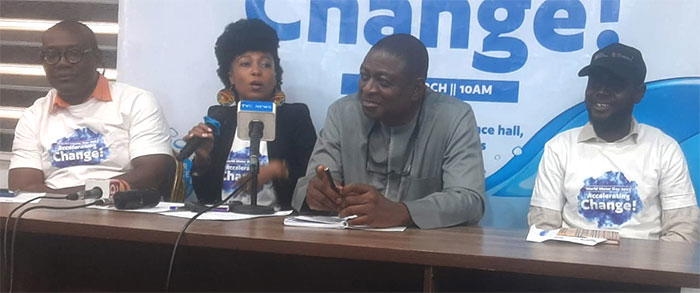
Fierce anti-privation advocate and rights organisation, CAPPA (Corporate Accountability & Public Participation Africa), sounded the above note of warning and advice at a briefing in commemoration of the World Water Day, marked annually on March 22.
The theme for this year is ‘Accelerating Change’.
Speaking at the event, Akinbode Oluwafemi, Executive Director CAPPA, noted that tellingly, not only were the firms pushing the water privatisation agenda in Lagos, across the country and continent French, but that their own government chased them away for failing.
“Right now,” Oluwafemi added, “France is back to remunicipalisation.”
Remunicipalisation is the return of previously privatised water supply and sanitation services to municipal (public/ government) authorities.
“Very disturbing accounts of the abuses of multinational corporations have led communities across the continent to reject water privatisation in its many forms, including so-called ‘public-private partnerships,” he said.
He also decried the role of water privatising corporations and their representatives in the United Nations gathering, questioning the role of AquaFed as coordinator of World Water Day conference in New York, USA.
Also speaking, Abiodun Bakare of the Nigeria Labur Congress, NLC, said it does not look like the governments in Nigeria have dropped the idea of privatising water resources.
“Although it is not yet uhuru,” he said, “but CAPPA, the Our Water Our Right Coalition and other CSOs have been fighting.
“And we need to do more. They (governments) have more resources to pursue their agenda. But we will not give up,” the unionist added.
On her part, Aderonke Ige, Associate Director at CAPPA, stated that 13 years after the United Nations declared water a human right, Africans, including Lagosians, are still battling affordability and availability.
“We want public ownership of water. And we must be heard,” she said.
“Privatisation failed across the world. It failed in Cameroon and Gabon. Ghana has deprivatised, while Niger has refused to renew the scheme,” she added.
Also speaking, Joint Action Front’s Achike Chude, an activist and writer, drew attention to how the collapse of the real estate, banking, automobile and other sectors across the world underscores how risky it is to put water resources in private hands.
“Privatisation is not the Holy Grail they make it out to be.
“They intentionally and systematically run down public corporations to drive the narrative that government has no business in business,” he said.
Equally at the World Water Day event were labour leaders and activists from various CSOs, including Amalgamated Union of Public Corporations, Civil Service Technical and Recreational Services Employees (AUPCTRE).
Meanwhile, as the World Water Day conference held in New York today, the United Nations children’s agency, UNICEF, notes that in Africa alone, 190 million children in 10 countries are at risk of three water-related threats — inadequate water, sanitation, and hygiene-related diseases.
The countries are Benin, Burkina Faso, Cameroon, Chad, Côte d’Ivoire, Guinea, Mali, Niger, Nigeria, and Somalia.
Disclaimer
Comments expressed here do not reflect the opinions of Vanguard newspapers or any employee thereof.