
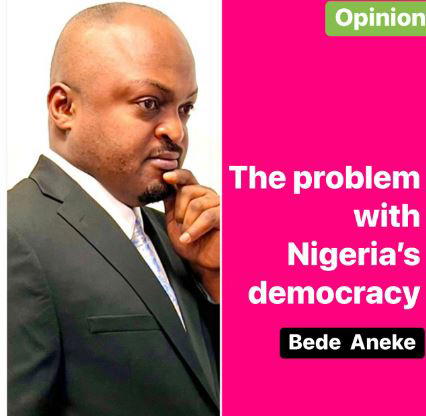
By Bede Aneke
The 32nd President of the United States (US), Franklin D. Roosevelt, in one of his famous words said, “the liberty of a democracy is not safe if the people allow individual to become powerful to the point where it becomes stronger than the democratic institutions.”
This, according to him, would breed fascism; which is the government by an individual, by a group, or any controlling private power.
Though Nigeria returned back to democracy in 1999 but 24 years down the line, the democratic principles like rule of law and respect of peoples’ will, which ought to guide the democracy, are being weakened by political leaders for their own selfish gains.
This defeats the beauty of democracy, which invests as well as encourages the people to exercise their power freely in a manner that encompasses the will and desires of the majority, as originated from Athens in modern day Greece.
Also, the above guiding principle of democracy cannot be said to be existing in Nigeria where individuals entrusted with political power device all means to maltreat and abuse the citizens with the same power entrusted to them.
Arguably, these leaders employ and use all means to suppress the will of the people, including rigging election as witnessed in the just-concluded controversial so called general election, by keeping the masses in abject poverty despite the abundance of human and natural resources the country is blessed with.
February 25 and March 18, 2023 saw Nigeria conduct the worst elections since return of democracy, though those who benefitted from that sham of an election will argue otherwise.
International observers, including foreign media, have qualified the elections with very negative adjectives, thus making the most populous black nation a laughing stock even before ‘small’ African countries.
No wonder, every election cycle, greedy politicians recruit unemployed youths as thugs to do their dirty jobs as witnessed in the 2023 general election and the unfortunate thing is that these youths-turned-thugs are paid peanuts to cause mayhem and dumped after the elections.
The ripple effects on the Nigerian society is recycling of poverty in the system. Or how would one explain that 133 million people in Nigeria are multi-dimensionally poor, according to the National Bureau of Statistics in 2022? A country so richly blessed.
This leaves one to wonder why this is so when it has been established that in democracy, the people wields the power. It is so because the less than one per cent in power have weakened institutions, especially the judiciary, that would have checked their excesses.
The judiciary, in fact, in Nigeria is at the whims and caprices of the ruling class. Needless to say that court rulings and judgments are disobeyed and there are no consequences because those at the corridors of power, are ‘untouchable’.
It is also greatly alleged that many judgments and rulings of the courts are procured, meaning that some of the Lord-judges superintending over the temples of Justice are corrupt and deliver judgments and make other judicial pronouncements according to the pockets of the highest bidder.
Security agencies, especially the police are mere errand boys, who take orders from those who steal from them.
The common man cannot protest because if he does, the oligarchs and semi-fascists will turn the police against the people despite the fact that one sure thing that democracy guarantees, is the right to peaceful protest.
In Nigeria, if you go out to protest, you either return home disappointed because you will be dispersed by mobile policemen (who sometimes fire live bullets at protesters instead of the conventional use of pressure water or rubber bullets which only applies where the protest turns violent), injured, arrested or end up being admitted at the hospital to be treated for injuries or ultimately end up dead.
Weak institutions thrive hence, since 1960, as Nigeria has not been able to conduct a credible election or census.
Process of electing leaders in Nigeria rather than improve worsens every four years despite the rejigging of the country’s electoral laws and millions of dollars budgeted for the electoral umpire, Independent National Electoral Commission (INEC).
It is only in Nigeria that politics is a career or profession, thanks to the weak institutions that had made politics a lucrative one and quickest way of amassing unquestionable wealth.
Nigeria’s politicians need to be schooled on what democracy is and should be taught to respect the will and desires of the people who power resides with.
They must learn to respect the rule of law and understand that no individual is bigger than the State but until then, the question remains – who will salvage Nigeria from bad governance?
Bede Aneke is a Public Policy Analyst and Executive Director African Network for Peace and Good Governance
Disclaimer
Comments expressed here do not reflect the opinions of Vanguard newspapers or any employee thereof.