
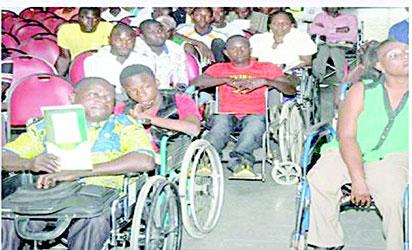
Group calls for creation of commission for persons with disabilities
By Ahmed Iyanda
We Included Application (Wi-App), a Civic organization, has expressed its disappointment over the inadequate of assistive materials at Polling Units that enable easy voting for People Living with Disabilities PWDs in the recently concluded Governorship and State House of Assembly elections in Nigeria.
This was contained in a post-election situation report signed by the convener of the group Obasanjo Fajemirokun.
According to him, Wi-App deployed 45 Election eyewitnesses in 11 states for the Governorship election that took place in 28 states across the nation.
He said, “45 WI-APP Election EyeWitnesses (E2) were on the ground in 11 states on March 18th, 2023, to contribute to this process by observing voting activities in 45 polling units.”
Obasanjo lamented that during the Governorship and House of Assembly elections on March 18th, 62% of sampled polling units had no assistive devices for People With Disabilities (PWDs), adding that the organization observed deploying one or more assistive devices in 38% of sampled polling units in11 states.
WI-APP, which is aimed at increasing the inclusion of women, young people, and persons living with disabilities (PWDs) in Nigeria’s electoral process, observed low participation of PWDs and high participation of women.
“From our collected data on women and PWDs, we observed 3% participation fromPWDs and 97% participation of women in our sampled polling units in 11 states.”
“PWDs participation in sampled polling units shows 16% participation in Lagos, 7% in Cross River, 1% in Enugu, 32% in Kano, 4% in Nassarawa, 7% in Niger, 13% in Ogun, 16% in Oyo, 1% in Kwara, no participation of PWDs in Ekiti and Ondo States.”
On Women participation by states, the Wi-App eye-witnesses observed in sampled polling units that 32.2%
participation in Lagos, 3.8% in Cross River, 0.4% in Ekiti, 2.1% in Enugu, 12.8% in Kano, 4.5% in Kwara, 3.4% in Nassarawa, 4.1% in Niger, 18% in Ogun, 15.5% in Oyo and 3.2% in Ondo States.
Obasanjo acknowledged that election officials arrived at the polling units on time but a lot of PWDs could not properly vote because of low assistive tools.
He said, “In the polling units observed, Wi-App observers noted the early arrival of INEC officials at polling units. Our findings reveal that over 52% of INEC ad-hoc staff started accreditation of voters at the polling unit between 8:00 am and 8:30 am, 27% started between 8:31 am to 9:00 am, 11% between 9:00 am to 9:30 am, 5% between 9:31 am to 10:00 am while 5% started accreditation from 10:00 am,” he said.
“This new development showed that the electoral body learned lessons from the last presidential elections and improved the early arrival of staff to commence accreditation,” he added.
In addition, Wi-App observed several incidents, including electoral process disruption by thugs in Darmanawa, Tarauni Local Government in Kano State; an attack on a journalist at polling unit 061, Chiroma ward, Lafia Local Government Area in Nassarawa State; and a child voter being accredited at Irete polling unit 010, ward 049 of Odogbolu Local government, Ogun State. Thugs also disrupted the voting process in Lagos and Ogun states. A female vote buyer was also caught secretly buying votes at polling unit 10, ward 049, Gwale Local government in Kano State and was subsequently arrested by security agents.
The Organisation however urged INEC to investigate reasons for the inadequate deployment of assistive tools to polling units with registered persons with disabilities, which can disenfranchise them. Also, “INEC should work more closely with EFCC and ICPC to be deployed to most polling units across Nigeria to curb vote buying.”
Disclaimer
Comments expressed here do not reflect the opinions of Vanguard newspapers or any employee thereof.