
…as millions of Nigerians lack access to WASH infrastructure
…UNICEF says 78m children in Nigeria suffer from poor water access
…Over 700m people globally face high, critical water stress-FAO
By Gabriel Ewepu, Abuja
AS Nigeria joins rest of the world to commemorate 2023 World Water Day, the Federal Government, Wednesday, lamented over worsening water-related disasters.
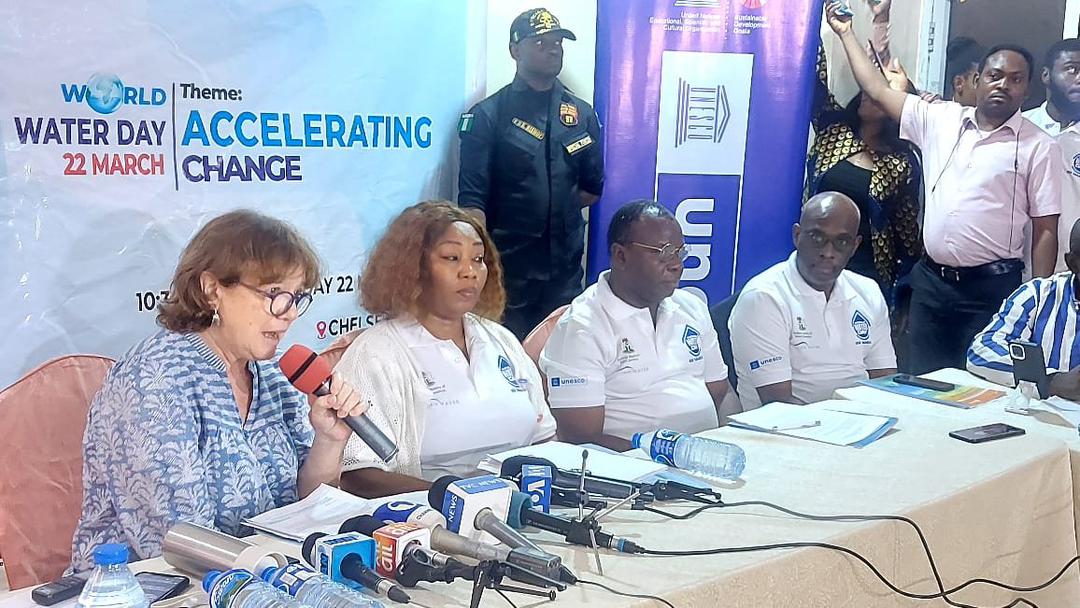
The Permanent Secretary, Federal Ministry of Water Resources, Didi Walson-Jack, made the statement during a media briefing to mark the 2023 World Water Day with theme ‘Accelerating Change to Solve the Water and Sanitation Crisis’.
Walson-Jack who was represented by the Director, Monitoring and Evaluation Federal Ministry, Agnes Aneke, said the essence of commemorating World Water Day is basically to raise awareness on the poor and vulnerable populations living without access to safe and clean water.
And its objective is to galvanize action towards active response to water crisis and seek out innovative measures to improve access to potable water supply while achieving the targets set out in the Sustainable Development Goal 6 – Water and Sanitation for all by 2030.
She said: “Water for all implies that the elderly, disabled, marginalized and poor people get access to clean drinking water and proper sanitation in line with Sustainable Development Goals (SDG) 6.1 and 6.2. Whoever you are, wherever you are you have right to water.
“The UN recognizes access to water as a human right which entitles everyone without discrimination to sufficient, safe, acceptable and affordable water for personal and domestic uses: which include water for drinking, sanitation, food preparation, personal and household hygiene, and others. As you are all aware that the slogans for WWD is ‘To a Thirsty man, a drop of water is worth more than a sack of gold’.
“Thousands lived without Love, but not without water. Water is the lifeblood of our world. From health and nutrition to education and infrastructure, water is vital to every aspect of human survival and well-being, and the economic development and prosperity of every nation. But drop by drop, this precious lifeblood is being poisoned by pollution and drained by vampiric overuse, with water demand expected to exceed supply by 40 per cent by decade’s end.
“Meanwhile, climate change is wreaking havoc on water’s natural cycle. Greenhouse gas pollution continues to rise to all-time record levels, heating the world’s climate to dangerous levels. This is worsening water-related disasters, disease outbreaks, water shortages and droughts, while inflicting damage to infrastructure, food production and supply chains.
“The theme of this year’s World Water Day ‘Accelerating Change to Solve the Water and Sanitation Crisis’ reminds us of the cost of these failures on the billions of people who lack access to safe water and sanitation.
“According to the United Nations, out of every 100 people on Earth, 25 fetch all their water from open streams and ponds – or pay high prices to buy water of dubious safety.
“22 relieve themselves outdoors or use dirty, dangerous or broken latrines. And 44 see their wastewater flow back into nature untreated, with disastrous health and environmental consequences. In short, our world is dramatically – and dangerously – off track to reaching our goal of safely managed water and sanitation for all by 2030.
“Therefore, to address these issues regarding water and sanitation, it is paramount to note that the premium attached to water infrastructure in national development reflects its value in the agenda of any nation. Investment in water infrastructure produces significant multiplier effects on several other sectors with tremendous impact on overall national development and must be well managed by all.”
Meanwhile, UNICEF Nigeria Chief of WASH, Dr Jane Bevan, said that one-third of children do not have access to at least basic water at home, and two-thirds do not have basic sanitation services.
However, Bevan said World Water Day gives an opportunity for collective action by stakeholders to improve access to water and sanitation in Nigeria after deliberation.
According to the UNICEF Nigeria Chief of WASH, an estimated 78 million children in Nigeria suffer from poor water access presently while a third of these children do not have access to water at their homes and two-thirds have no access to basic sanitation facilities.
She also lamented that Nigeria is among 10 countries in Sub-Saharan Africa that has the heaviest burden of diseases traceable to poor WASH infrastructure.
She said: “Diseases such as cholera kill children most and a third of the children in this country do not have access to safe water. Together with the issues of accelerating climate changes and extreme weather, we are seeing increased flooding storms, rainfall, increased temperatures which means we have more cholera than in the past.
“So we need to do more not less for the children of Nigeria, we owe it to them to really come together and invest more for water and do our best to reach everybody.”
In a goodwill message, the Country Representative, Food and Agriculture Organisation, FAO, Fred Kafeero, disclosed that over 700 million people globally face high and critical water stress, while over 90 per cent of natural disasters remain water related.
Kafeero, who was represented by Oluseyi Fabiyi, pointed out that water is an essential element “for every aspect of development for Better Production, Better Nutrition, a Better Environment, and a Better Life.
“As we commemorate this year’s World Water Day, we need to create synergies by joining hands and working together. Let us value every drop of water and keep our planet blue and clean. Let us make everyday World Water Day.
“The UN 2023 Water Conference, currently ongoing in New York, plans to forge an international Community commitment to the Water Action Agenda to protect one of humanity’s most critical resources. Agriculture, the sector most dependent on freshwater, must be central to this agenda.
“Over 700 million people in the world face high and critical water stress and over 90 percent of natural disasters are water related. The situation is worsening. Global water availability and quality are deteriorating, Climate change is intensifying, Competition between sectors and countries is increasing.
“Agriculture currently accounts for 72 per cent of freshwater withdrawals. On current trends, an additional 35 per cent in water resources will be needed by 2050 to meet growing demand for food, fibre and feed.
“This is hugely worrying for efforts to end hunger and poverty, because there can be no food and agriculture, and the livelihoods it supports, without clean and sufficient water – for irrigation of crops, for livestock, and for the many species that live in aquatic ecosystems.
“Agriculture – including forestry, fisheries and aquaculture – also plays a crucial role in the management of surface water, ground water recharge and even circulation of atmospheric water, thanks to forests.
Under the FAO and United Nations Environment Programme-led UN Decade on Ecosystem Restoration, country-led projects, supported by partners, are revitalizing hundreds of millions of hectares of vital ecosystems – from forests to oceans and wetlands.”
He also disclosed that, “In Nigeria, FAO is supporting the Federal Ministry of Water Resources to promote drip irrigation systems as a way of sustainable water management in selected irrigation schemes.
“FAO also collaborated with NAOC in partnership initiative to establish 22 water schemes powered by photovoltaic systems to foster access to water and ameliorate the water needs of the IDPs.”
Disclaimer
Comments expressed here do not reflect the opinions of Vanguard newspapers or any employee thereof.